

I’ve fallen in love with a particular technique for shoulder reduction that allows the patient to self reduce. This minimizes pain experienced during the procedure as well as avoids the need for conscious sedation. I call it the modified Boss-Holzach-Matter maneuver, or the Boss Stokes maneuver (because I couldn’t think of anything witty to do with Holzach-Matter).
The technique was first described in a paper by Boss-Holzach-Matter in 2014. The technique as described has the patient sitting on the gurney, with the ipsilateral knee brought up and hip flexed as much as possible with both hands around the knee.
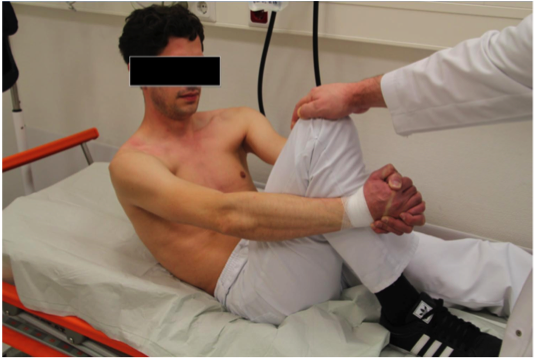
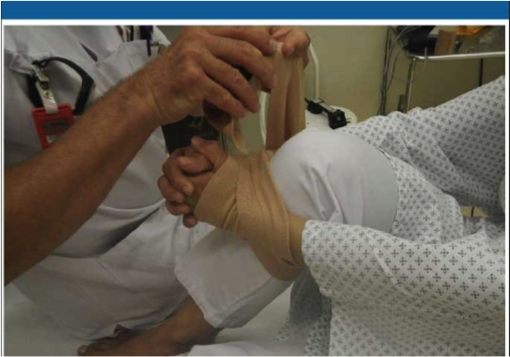
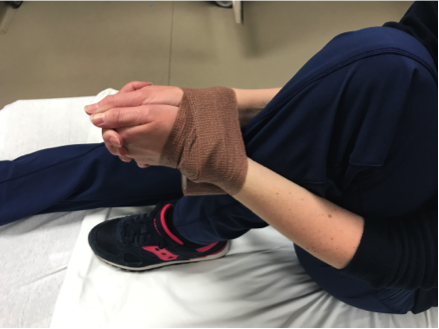
A wrap is used (I prefer Coban) to secure the hands and wrists around the knee. The patient is then told to slowly lean back, allowing the arm to completely extend. The patient provides traction/contraction themselves as they pull their hands back against the knee.
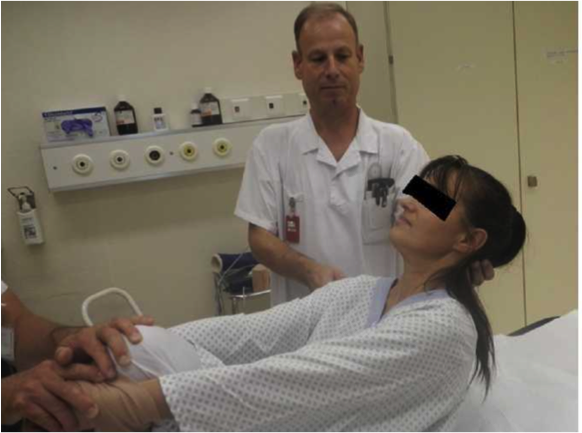
I find that a little modification to this technique has improved my success rate with it.
The step by step Boss Stokes Maneuver:
- Proper pain control is paramount to ensure pt can perform proper traction/counter traction for self reduction
- I give 100mcg of fentanyl (assuming it’s appropriate for pt’s age/condition) initially, and then have another 100mcg of fentanyl at the bedside to divide up and give in small amounts periprocedure if needed
- Depending on anatomy and patient preference, sometimes I will perform a hematoma block to help with anesthesia
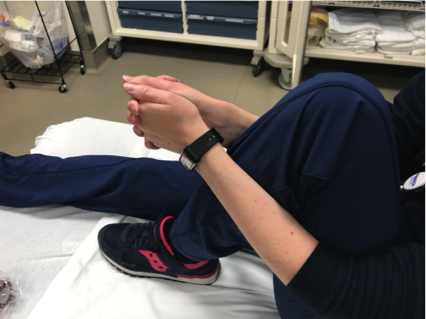
- Have the patient sit up on the stretcher with the ipsilateral knee brought up as far as possible. Have the pt slowly bring their dislocated arm forward (proper pain control needed) and wrap it with the other hand around the knee. See image below – make sure the wrists are touching/wraped around the knee, not just the fingers.
- Place the head of the bed flat
- Sit on the patient’s foot to prevent any movement or slippage. At the same time, place your hands on the patient’s forearms.
- Instruct the patient to start leaning back. Their goal is to straighten their arms out and to attempt to slowly lean back and try to get their head to touch the flat stretcher
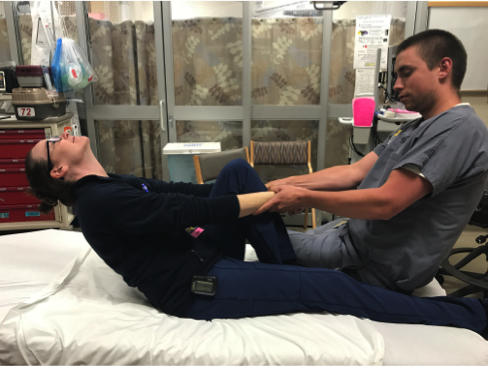
- While the patient is doing this, help provide counter traction by leaning back yourself and pulling counter traction on the forearms.
- As the patient gets farther down towards the stretcher, it is paramount to ensure they do not give up and come back up. They need to provide constant slow pressure to fatigue the muscles and achieve proper reduction
- If spasm is noticed in the arm muscles, you can help reduction with massage. If you have another provider with you, concurrent scapular manipulation and massage can help
- With continued traction/counter traction and the patient attempting to lay back on the stretcher, reduction will be achieved
I’ve found that sitting on the patient’s foot, helping with counter traction, and massaging any spasming muscles has greatly improved my success rate. The entire procedure takes me about 5-10 minutes to perform, but does require a cooperative patient.
 AOMC FOAMed