
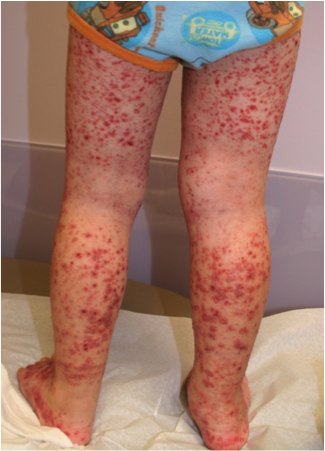
A 2 year old male presented to the ED for groin swelling. His mom stated that everything started with a viral illness 2 weeks ago, which then progressed into multiple areas of swollen joints associated with pain and the inability to walk. One day prior to presentation a red, non painful rash appeared on his inner thighs and left buttocks. On the day of presentation, the patient’s groin, penis, and scrotum became swollen. On arrival, patient’s vital signs were within normal limits. He had edema to his penis and scrotum without any tenderness to palpation. Purpura was noted on his buttocks and thigh. His abdominal exam was benign.
IgA vasculitis (Henoch-Schönlein purpura (HSP)):
IgAV (HSP) is the most common form of systemic vasculitis in children. 90% of cases occur in the pediatric age group. In contrast to many other forms of systemic vasculitis, IgAV is self-limited in the great majority of cases.
Diagnosis:
The diagnosis of IgAV (HSP) is based on clinical manifestations of the disease, and laboratory markers are typically non-specific.
There are four main clinical features of HSP:
- Palpable purpura primarily involving the buttocks, thighs, legs, and less frequently the arms. (see Image)
- Gastrointestinal symptoms including vomiting, diarrhea, abdominal pain, and GI bleeding. Importantly, intussusception is rare but may be a complication in 2-6% of cases (70% are ileoileal, rather than the classic ileocolic).
- Polyarthralgias:usually transient or migratory, typically oligoarticular (one to four joints), and nondeforming. It usually affects the lower extremity large joints (hips, knees, and ankles) or less commonly the upper extremities (elbows, wrists, and hands).
- Hematuria and proteinuria (nephritis)
The diagnosis is straightforward when patients present with the classic signs and symptoms (palpable purpura of the lower extremities and buttocks in combination with two or more of the other typical disease manifestations). However, the classic rash of IgAV is not the initial presenting sign in approximately one-quarter of affected individuals which can make the diagnosis challenging.
IgAV can also involve other organ systems such as the scrotum causing scrotal swelling and tenderness. If scrotal tenderness is present, the presentation may mimic testicular torsion. Patient’s can develop orchitis with IgAV and testicular ultrasound should be considered.
Management:
The vast majority of patients with IgAV recover spontaneously. Thus, care is primarily supportive and includes adequate hydration, rest, and symptomatic relief of pain. NSAIDs are appropriate for pain and symptom control unless there are contraindications (GI bleed, glomerulonephritis). Steroids are sometimes used for severe disease but in the ED setting they should probably be deferred until expert consultation is obtained.
After the diagnosis is made clinically, a urinalysis should be ordered in all patients to look for signs of cellular casts, hematuria, and proteinuria. If abnormal, consider obtaining a serum creatinine level, renal ultrasound, and nephrology consult.
If the patient has abdominal pain, an ultrasound should be obtained to check for the possibility of intussusception. If the patient has testicular pain, a testicular ultrasound should be obtained to look for signs of torsion, orchitis, or epididymitis.
Most patients may be cared for in the ambulatory setting; however, severe abdominal pain, severe vomiting, or severe renal disease may require admission. Follow-up is important as the initial urinalysis may be negative, however the child may go on to develop nephritis during the disease course.
Case Resolution:
The patient’s physical exam and history were consistent with HSP. A UA was obtained and was negative. He was well appearing and his abdominal exam was benign. Although he had scrotal edema, he had no tenderness to palpation. No labs or imaging were obtained. After a dose of ibuprofen, the patient was tolerating PO and able to ambulate without difficulty. Follow-up was established for the patient and the patient was able to be discharged from the ED.
Take Home Points:
- HSP is a clinical diagnosis
- Clinical manifestations of the disease include palpable purpura, arthritis/arthralgia, and edema.
- Watch out for intussusception and scrotal complications
- A UA should be ordered in all patients
- Management is primarily supportive, and close follow-up is needed
 AOMC FOAMed